0
Skip to Content
Amplifying Potential Therapy
About Us
Billing/Insurance
Neurodiversity-Affirming Care
Speech Therapy
Feeding Therapy
Interoception
Adaptive Personal Training
Team
Contact
Amplifying Potential Therapy
About Us
Billing/Insurance
Neurodiversity-Affirming Care
Speech Therapy
Feeding Therapy
Interoception
Adaptive Personal Training
Team
Contact
Folder: APT Overview
Back
About Us
Billing/Insurance
Folder: Services
Back
Neurodiversity-Affirming Care
Speech Therapy
Feeding Therapy
Interoception
Adaptive Personal Training
Team
Contact
Venn diagram comparing autism and apraxia, showing differences in social skills, language, planning, and speech, with shared features of late speech or non-verbal communication, diagnosed by psychologists or speech-language pathologists, and the use
An infographic explaining ideomotor apraxia, its characteristics, connection to autism, and ways to support affected individuals, including breaking down motor tasks, coaching using body parts and verbs, and repeated practice in natural environments.
Flowchart illustrating strategies for presuming competence in non-speakers, emphasizing inclusion, acceptance, avoiding misinterpreting behavior, and focusing on motor instead of cognitive abilities.
An informational graphic with tips for improving success with AAC systems, including addressing motor planning, content presentation, communication perspectives, teaching models, and age-appropriate strategies. The graphic features icons like a megap
Comparison chart of visual skills, listing the differences between visual motor and visual perception, including skills like coordination, memory, convergence, discrimination, and efficiency.
Comparison chart contrasting automatic versus purposeful movement. Automatic movement is characterized by involuntary actions, lack of precision, repetitive motor patterns, limited adaptability, association with dysregulation or lack of engagement, a
A colorful chart with the title "We challenge you to look beyond behavior" and lists potential areas for behavioral observation, including interoception, emotional regulation, visual processing, sensory processing, executive functioning, lack of enga
Six tips for creating a conducive environment for spelling sessions at home, presented in a colorful infographic with numbered circles and brief descriptions.
An infographic titled 'What Is Interoception?' with a definition explaining that interoception is the sense that enables perception of internal body sensations like hunger, thirst, and temperature. It also shows how addressing interoception can suppo
Diagram showing two approaches to regulation: compliance-based approach which may negatively impact interoceptive experiences by teaching individuals to disregard body signals to follow demands and seek reinforcement; and neurodiversity affirming app
Infographic titled "The Benefits of Presuming Competence, A Non-Speaker's Perspective" with six colorful scalloped circles listing benefits, including increased regulation, respect, confidence in taking risks, feeling understood, viewing opinions as
Infographic titled "How AAC Supports Verbal Speech" with numbered points explaining the benefits of AAC, including opportunities for conversation, language models, reducing speech pressure, improving confidence, consistent verbal models, mental struc
Infographic titled "Ways to speak to your child about their disability" with five speech bubbles explaining different ways to communicate with children about disabilities, including sharing strengths, common goals, helping them gain control, recogniz
A colorful infographic listing signs of challenges with interoception, including limited awareness of bodily signals, need for support to calm down, knowledge of regulation strategies but not when to use them, intense emotions, and others.
Infographic titled "Our Approach to Social Skills" listing five strategies, each with a colored background: teaching interoception skills, focusing on self-advocacy and body autonomy, building upon client strengths and goals, teaching perspective tak
A visual infographic about Gestalt Language Acquisition, highlighting points such as language learning through phrases, strong intonation, single-multiple word phrases, and early inflexibility, with extras about skip single word stage, focusing on ph
Infographic about autism and OCD, highlighting sensory processing differences, repetitive thoughts and behaviors, neurological conditions, and diagnostic statistics.
Diagram illustrating four quadrants of sensory processing: Registration/Bystander, Seeking/Seeker, Avoiding/Avoider, Sensitivity/Sensor, connected in a circular flow. Title: 4 Quadrants of Sensory Processing, Winnie Dunn's Sensory Processing Framewor
Educational poster explaining children with higher and lower registration patterns, called 'bystanders.' It mentions that children with higher registration patterns may require more cues, and bystanders may be distracted or uninterested. It also note
A pink infographic titled 'Seeking/Seeker' explaining that children with higher scores on seeking patterns actively seek sensory stimuli, such as making noises, rubbing, or touching objects, while children with lower seeking patterns may need more as
A chart titled 'Avoiding/Avoider' explaining patterns of children with higher and lower avoiding tendencies. It describes how children with higher avoiding patterns prefer structure and consistency, and may seem controlling or rigid, while children w
An infographic explaining children with different sensory sensitivities, including how children react to sensory stimuli, their behavior, and considerations for different sensitivity patterns.
An infographic titled "The Truth About Spelling to Communicate (S2C)" comparing myths and facts. The myth section states S2C is only for individuals with verbal communication challenges, and is a one-size-fits-all approach, and a quick fix. The fact
A comparison chart with two columns, the left labeled Myth in pink and the right labeled Fact in green. Myth states 'S2C is only for children,' 'Non-speakers cannot grasp complex concepts through spelling,' and 'S2C hinders the development of other c
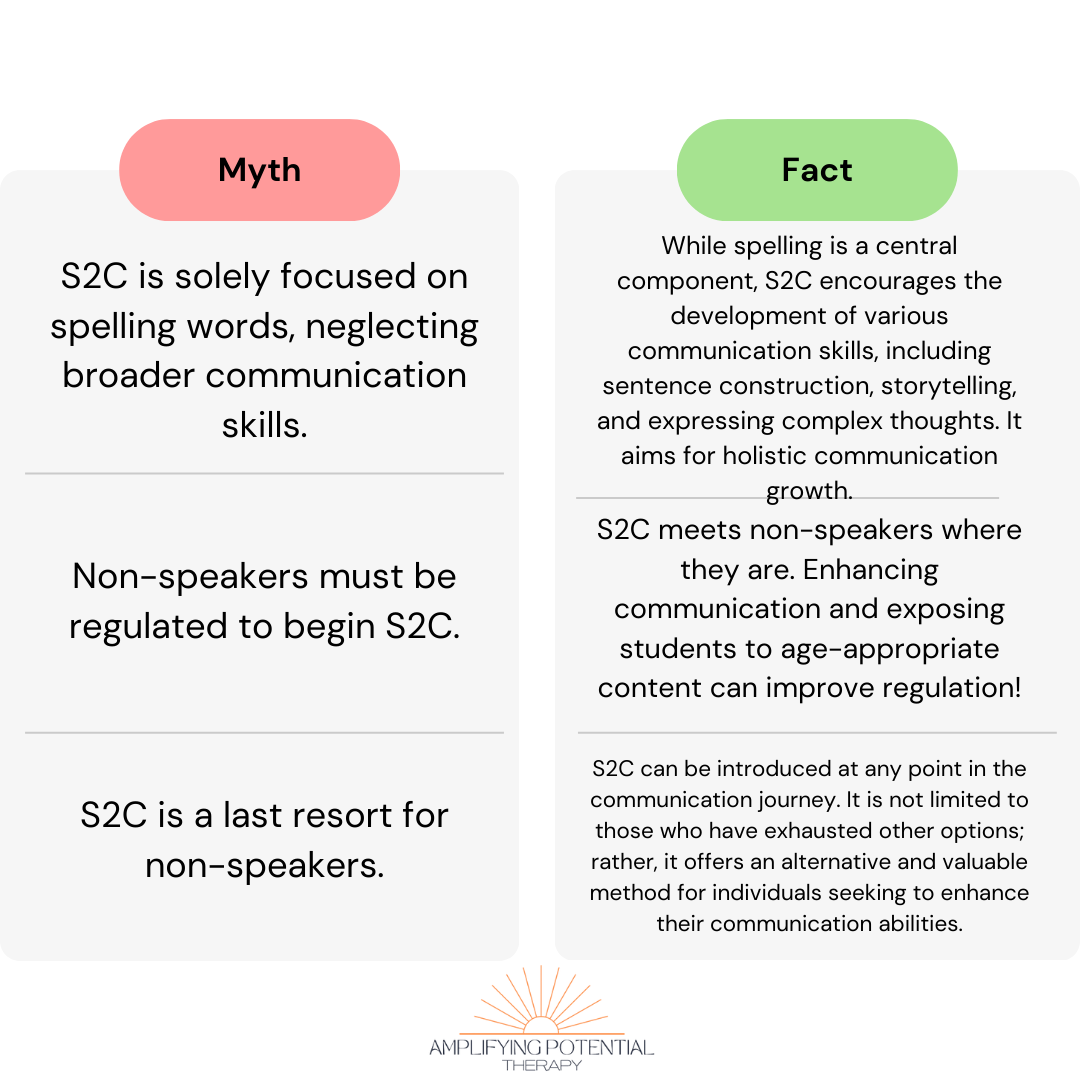
Comparison chart with Myth and Fact sections about S2C, highlighting misconceptions about focusing only on spelling words and emphasizing the importance of holistic communication development, including sentence construction, storytelling, and express
Cover page with the words 'Challenging Behavior' crossed out and replaced with 'Challenges with Interception'. Includes botanical illustrations and the logo 'Amplifying Potential Therapy'.

Location

Conveniently located in the Chicago suburbs
609 Landwehr Road
Northbrook, IL 60062

Connect with APT

amplify.apt@gmail.com
New Clients: 224-285-9748
Current Clients: 224-300-8866
Contact Form